
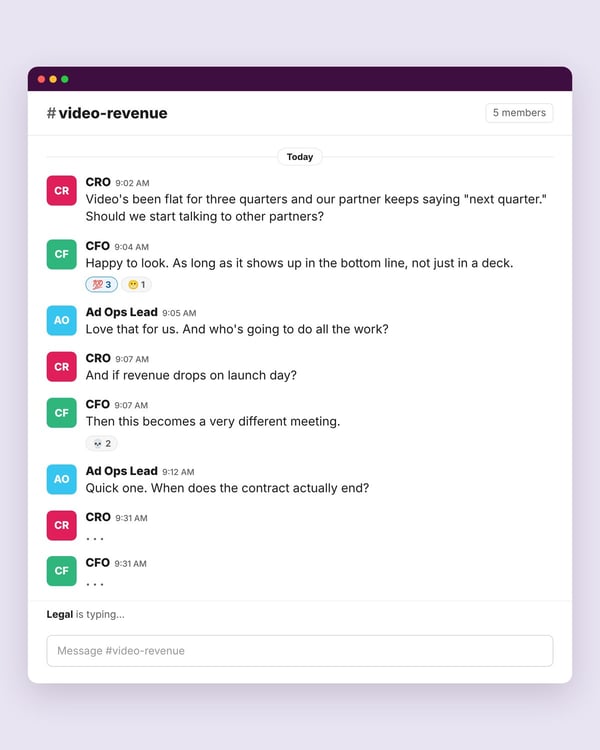
You're fairly sure your video partner is leaving money on the table, and you've started looking at alternatives. The hard part is convincing everyone else. Switching a revenue line this size takes a business case, a plan for the work, and a good answer for when your stakeholders ask what happens if revenue drops.
The timing works in your favor. AI answers are already cutting into clicks: Google Search referrals to news and media sites fell 40.2% between July 2025 and July 2026, according to Chartbeat data. Media leaders expect the decline to continue, per the Reuters Institute. With fewer visits, each one has to earn more, so how well your video partner monetizes every impression matters more than it used to. And the budget is there: the IAB expects US digital video ad spend to pass $80 billion in 2026, growing nearly 20% faster than the total ad market.
What to Look for in an Alternative Video Monetization Partner
The right alternative is the partner that earns more from every visit and takes on most of the work of switching. Before you compare names, check each option against four things:
- It grows session revenue, not just CPM. It works on every lever of a visit, from video coverage and engagement to real-time pricing, instead of chasing a higher CPM on one line item.
- It can put video on every page. It supplies relevant video for pages that have none, so you open new inventory without extra editorial work.
- It puts its share of the work in writing. You know who owns each migration task before you sign.
- It gives you a safe way to switch. It protects your direct campaigns, starts with a controlled test, and agrees on a rollback rule up front.
To get there, there are three questions you need to take into account when going into this kind of process: why switch, how much work it will cost the team, and what your options are if revenue drops.
1. What Is the Business Case for Switching?
Shift your mindset from CPM to session revenue: what each visit earns across all of its pageviews and impressions. When search traffic is under pressure, that's the number that matters. CPM only tells you what one impression sold for. It says nothing about how many impressions a visit produced, how many went unfilled, or whether the reader stayed for a second page.
That's why CPM can rise while total revenue falls. Raise your floors and CPM goes up, but fill drops. Stack more ad units on a page and impressions go up, but slower pages and clutter push readers away before their next pageview. Each move looks good on a single line item and hurts the session.
Session revenue puts all of it in one equation:
Session revenue = Pages per session × Video impressions per page × Fill rate × CPM / 1000
Every factor in that equation is a lever. AI-driven pricing moves only the last one, so a partner that just optimizes price is working on a fraction of the problem. These five steps move the rest.
Step 1: Put video on every page
A page with no player earns no video revenue, whatever your CPM. Map your coverage and close the gaps with relevant video, from your own library or a partner's content marketplace.
Step 2: Match the video to the page
Relevant video holds attention. Readers who keep watching see more ads, and readers who find what they came for are more likely to click through to another article. Contextual matching lifts both completion rates and pages per session.
Step 3: Move from outstream to in-stream where you can
Outstream units are easy to add, but buyers pay more for in-stream, where the ad plays with content the reader chose to watch. A content library that fits your pages is what makes in-stream possible at scale. We cover this in more depth in From Outstream to In-Stream.
Step 4: Protect the experience that keeps the session going
Player load time, ad density, and placement decide whether a reader stays for page two. A fast, viewable player keeps both readers and buyers. A slow one costs you impressions on this page and pageviews on the next. Weigh every extra ad unit against the pageviews it might cost.
Step 5: Price and route every impression in real time
Only now does pricing come in. Instead of floors set once and left alone, smart ad server, equipped with machine-learning yield engine, prices each impression and routes it to the demand most likely to pay for it, balancing CPM against fill. It works best on top of the first four steps, not instead of them.
This is where your choice of partner counts. Ask each alternative which of these five levers it moves, and how. Can it help you earn more from the same traffic? Will its technology hold up as traffic declines? A partner that only talks about CPM is selling you a line item, not a session.
To build the case, pull these numbers:
- Benchmarks for how readers behave on your site, such as dwell time, exit rates, and where your ad inventory sits on the page.
- Session revenue and RPM over the last 6 to 12 months, to show the trend on your current setup.
- Fill rate and viewability by page type, to show where money is being left behind.
- Your video coverage. Map out the pages with no video at all. Each one is inventory you're not selling.
- A realistic lift that makes the move worth it to your organization. Apply a conservative uplift to your current video revenue to show the annual upside.
2. How Much Work Will the Switch Cost the Team?
Less than most teams expect, if the partner does its share. A good partner handles integration support, campaign setup, player tuning, video supply, demand, and reporting. What matters most is the short list of tasks that stay with your team.
The tasks that stay with you are the ones that set your timeline. Work back from the last day your old partner will serve, and bring your app developers, CMS provider, and data team in at kickoff. Their release cycles are the most common reason a launch date moves.
3. What Are Your Options If Revenue Drops?
This is the question that stalls most switches, so answer it with a plan, not a promise. Four safeguards cover it.
Protect direct campaigns first. They're sold against delivery commitments, so they're the one thing that can't break. Every live and upcoming campaign should be set up and tested in the new platform before any traffic moves. Flag sponsorships and roadblocks early, and make sure your advertisers still receive the KPIs they expect: viewability, verified impressions, and brand safety measures.
Get ads.txt right before launch. A missing reseller line doesn't trigger an alert. That demand just quietly stops bidding, and it shows up later as lower fill. To keep that from happening:
- Add the new partner's lines, including every reseller line.
- Keep the old partner's lines and tags live until you're at full volume.
- Check that seller IDs match each partner's sellers.json, and update app-ads.txt if you have apps.
- If a partner shows near-zero bids in the first days, check ads.txt first.
Ramp up gradually on live traffic. QA in staging tells you the integration works. Only live traffic tells you whether it makes money. Go live on a small share of traffic, on pages that represent your mix, and assess performance closely on the metrics that matter: revenue per visit, fill, viewability, completion rate, and player load time and errors. Increase the share step by step, moving to full rollout once the numbers show the new setup is performing.
Agree on a rollback rule. Decide in advance what result moves traffic back and who makes the call. You'll probably never use it, but it's often what gets the switch approved.
Choosing the Right Alternative
Finding an alternative is the easy part. Getting the switch approved takes three things: a business case built on session revenue, a written split of the work, and a plan that protects revenue while traffic moves. The partner worth switching to is the one that helps you deliver all three. It earns more from the same traffic, takes on most of the migration, and lets you test before you commit.
If your contract ends in the next few months, now's the time to build the case. For what to ask any video platform before you sign, see our guide to choosing an online video platform.
Planning a switch?
Request a migration plan review. Share your contract end date and current setup, and one of our video experts will map a timeline, fill in the work split for your stack, and flag ads.txt and demand gaps.